
Can Branded Calling restore our faith in phone calls?
Businesses are increasingly struggling to reach their customers, current or potential, via phone calls – and who can blame them, with people receiving eight suspicious calls a month on average. Can telcos restore consumer faith with branded phone calls?
Have you been brave enough to answer an anonymous phone call lately?
Looking at my own recent call history, of the last ten calls I’ve had on my mobile, six were suspected spam or potential fraud, and looking up the numbers on sites like Who Called Me? confirms these suspicions.
Phone calls were once the most direct, credible way to contact someone, but over the last few years, voice services have tumbled dramatically, in one of the biggest, quietest shakeups in customer behaviour, and it’s had significant consequences.
It's no surprise that people are avoiding calls from unknown and anonymous numbers. According to Nationwide, people in the UK receive on average eight “suspicious” phone calls per month, while Uswitch reports that 50% of people won’t answer an anonymous phone call without establishing who is calling first.
Despite this, the phone remains one of the preferred and most-used ways to contact businesses, far more than via chatbots, online forms or apps.
But organisations are struggling to reach their customers – contact centres waste time on repeat attempts, and consumers miss important calls from their bank, healthcare provider, utilities and government services.
The result is a negative feedback loop as consumers ignore calls, businesses try to call more often to get through, and the overall experience worsens. This chasm in credibility is due to three factors:
- High-volume automated calling has normalised nuisance and scam calls.
- Caller ID spoofing has made it easy to imitate trusted numbers.
- Device-level spam filtering, while helpful, has trained people to distrust any unrecognised number.
Together, these forces have broken the implicit trust that once underpinned voice services.
From the consumer perspective, the problem is unwanted intrusion and fraud. From the enterprise perspective, it is declining contact rates and rising operational cost. For telcos, it represents the erosion of trust in one of their core services.
In the UK, though the Telephone Preference Service (TPS) maintains a list of numbers that don’t want to receive sales and marketing calls, this doesn’t apply to automated marketing calls because the law only applies to people.
Legitimate organisations need to be able to effectively communicate with their customers again – but consumers also need a reason to trust that the call is genuine. As businesses push customers towards lower-cost or automated digital options, they should spare a thought for the advances made in voice services of late – services such as Branded Calling.
Rather than relying on just a bare phone number, Branded Calling aims to provide a verified identity and context the consumer can act on.
The term “branded phone calls” is sometimes used loosely, so it helps to separate the concept into layers:
- Verified caller identity
The network attests that the caller is who they claim to be, not spoofed. - Brand display
The recipient sees a brand name (and sometimes a logo) rather than only a number. - Rich call experience
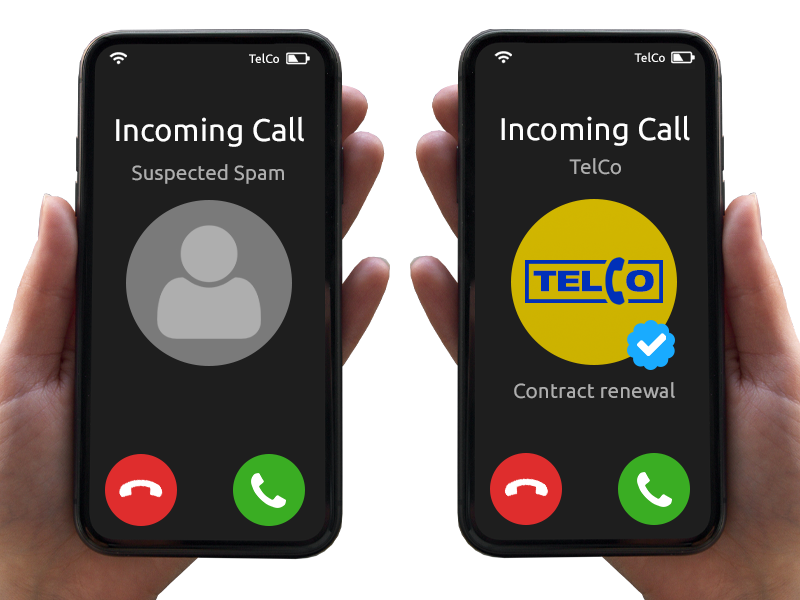
On supported devices, the call screen may include additional data, e.g. “Pay bill,” “Reschedule,” “Open support chat”, etc., to encourage the consumer to answer the call.
One example is Vodafone, which recently rolled out Branded Calling in the UK, following the launch of a similar service in Germany back in 2023.
Branded Calling employs Vodafone’s Verified Caller Network API, built to open-source CAMARA standards. Behind the scenes, the service authenticates calls in real time, verifies a caller’s identity, and confirms the call is authorised by the organisation, reducing the risk of impersonation or hijacking.
Even if the number isn’t saved as a contact, customers see trusted information alongside the phone number on their screen, such as a company name, logo, and even a brief explanation for the purpose of the call, or a flag indicating a high-priority call.
Other telcos that are rolling out similar branded phone call services include AT&T, the first to launch In-Network Branded Call Display, in partnership with TransUnion. Verizon and T-Mobile have since followed suit, while NTT Docomo in Japan, SK Telecom in South Korea, and Telstra in Australia have also launched similar services. Furthermore, a conglomeration of Indian telcos including Jio and Airtel now offer Caller Name Presentation (CNAP).
However, it is important to distinguish between basic caller authentication and full Branded phone calls.
Branded phone calls typically builds on frameworks such as STIR/SHAKEN, a suite of protocols established by The Alliance for Telecommunications Industry Solutions (ATIS) in 2017 to combat caller ID spoofing by enabling networks to verify the legitimacy of a given calling number.
STIR (Secure Telephone Identity Revisited) defines how calls are cryptographically signed and verified; SHAKEN (Signature-based Handling of Asserted information using toKENs) defines how those mechanisms are applied in networks to verify the calling number.
STIR/SHAKEN enables number verification, but it does not by itself provide brand display, rich call data, or enterprise onboarding models – those sit on top.
When a call is placed, the originating service provider determines how confident it is that the caller is entitled to use the calling number, assigning an attestation level that reflects whether it fully trusts the caller and their number. Once the attestation decision is made, the originating provider creates a digital token, known as a PASSporT, that is attached to the call signalling, typically within SIP headers, and is routed through the network.
When the call arrives, the terminating service provider retrieves the public certificate associated with the originating provider and checks that the signature is valid and has not been altered in transit. The terminating provider can then decide how to handle the call. This might include displaying a “verified caller” indicator to the end user, applying analytics to assess the likelihood of spam or fraud, or taking network-level actions such as allowing, labelling, throttling, or blocking the call.
Solving the trust issue is not just a customer experience problem – it is a strategic question for operators.
As traditional voice revenues continue to flatten or decline, the value of the network is increasingly defined by the trust and assurance it can provide. This must become an integral capability of the network, instead of an assumed property – one that is built, maintained and proven by the telco.
Operators must increasingly become authenticators, rather than passive traffic conduits, deciding how they validate brands, exchange trust signals with other networks, and ensure a consistent experience.
Branded calling pushes the model towards proactive assurance, where legitimate callers are checked upfront and given a clearer path to reach customers. This requires new operational capabilities: onboarding and vetting enterprises, managing credentials or attestations, monitoring ongoing behaviour, and intervening when a previously trusted caller shows signs of abuse.
With this expanded role comes greater responsibility around data and privacy. Telecoms companies will need robust governance models and transparent communication with both enterprises and end users. Used carelessly, it risks exposing telcos to reputational damage or regulatory scrutiny. Trust, once productised, also becomes a liability if mismanaged.
Broad adoption is what makes branded calling effective, so pricing and onboarding models must encourage scale without compromising standards. Telecoms companies must avoid creating a system where legitimacy is something that only large enterprises can afford; if smaller businesses or public services are excluded by cost or complexity, the overall ecosystem suffers.
Branded calling creates an opportunity for telcos to rethink their role in the voice value chain and offer services that help restore confidence in a channel that has been eroded. The future of voice is making calls meaningful again by enabling verified identity, clearer intent, and safer experiences that enterprises are willing to pay for because they directly impact customer engagement, fraud reduction, and operational efficiency.
Those that succeed will not only reduce spam and fraud, but also restore voice services as a trusted, high-value channel for engagement.
