
The BSS/OSS decisions every CSP needs to get right

BSS/OSS transformation remains one of the biggest and most complex undertakings for CSPs, but many of the decisions that determine whether a transformation succeeds are made much earlier. Why do so many transformation programmes struggle before a single line of software is deployed?
It’s tempting to assume that the biggest risks in BSS/OSS transformations emerge during implementation.
Data migration, integration, testing and cutover certainly deserve attention, but in reality, many transformation programmes are already on the path to failure long before even a vendor is selected.
A recurring problem is that many organisations focus on buying technology instead of defining the business problem they are trying to solve.
BSS/OSS transformation is an opportunity to rethink how products are launched, customers are served, and services are delivered. Without a clear understanding of the desired business outcomes, procurement quickly becomes an exercise in comparing feature lists rather than evaluating which solution will deliver the greatest long-term value.
Start with outcomes, not features
One of the most common mistakes is using the existing platform as the blueprint for the new one. Requirements become a catalogue of everything the legacy system does today, regardless of whether those processes still make commercial sense. A more effective approach is to begin with business outcomes that are measurable:
- Reducing time-to-market
- Improving billing accuracy
- Increasing self-service adoption
- Accelerating service activation
When every requirement can be traced back to one of these outcomes, procurement decisions become significantly easier. Features stop being an end in themselves and become a means of delivering business value.
Procurement is a business exercise
Although BSS/OSS is often viewed as an IT programme, successful transformation requires alignment across the entire organisation.
Business leaders, finance, operations, security, procurement and enterprise architecture all bring different priorities. Bringing these stakeholders together early helps establish clear governance, agreed success measures and realistic scope boundaries before procurement begins.
Without this alignment, organisations frequently encounter familiar problems:
- Scope continually expands.
- Different departments define conflicting priorities.
- Integration responsibilities become unclear.
- Procurement focuses on price instead of long-term operational value.
Define the boundaries before selecting the platform
Another recurring challenge is failing to decide what should actually be modernised.
No BSS/OSS platform exists in isolation. Existing applications, digital channels, payment systems and network platforms all need to be considered. Defining which capabilities belong within the transformation programme – and which remain outside it – reduces delivery risk and makes vendor proposals far easier to compare.
Similarly, agreeing systems of record and data ownership early helps prevent a common cause of programme delays: uncertainty over which application owns critical customer, product or billing data.
Ask better questions
Effective BSS/OSS procurement is about more than functionality.
Questions around API-first architecture, upgradeability, governance, deployment models and operational maturity are often better indicators of long-term success than extensive feature matrices. Evaluating these factors early helps buyers distinguish between platforms that merely satisfy today’s requirements and those that can continue to evolve with the business over time.
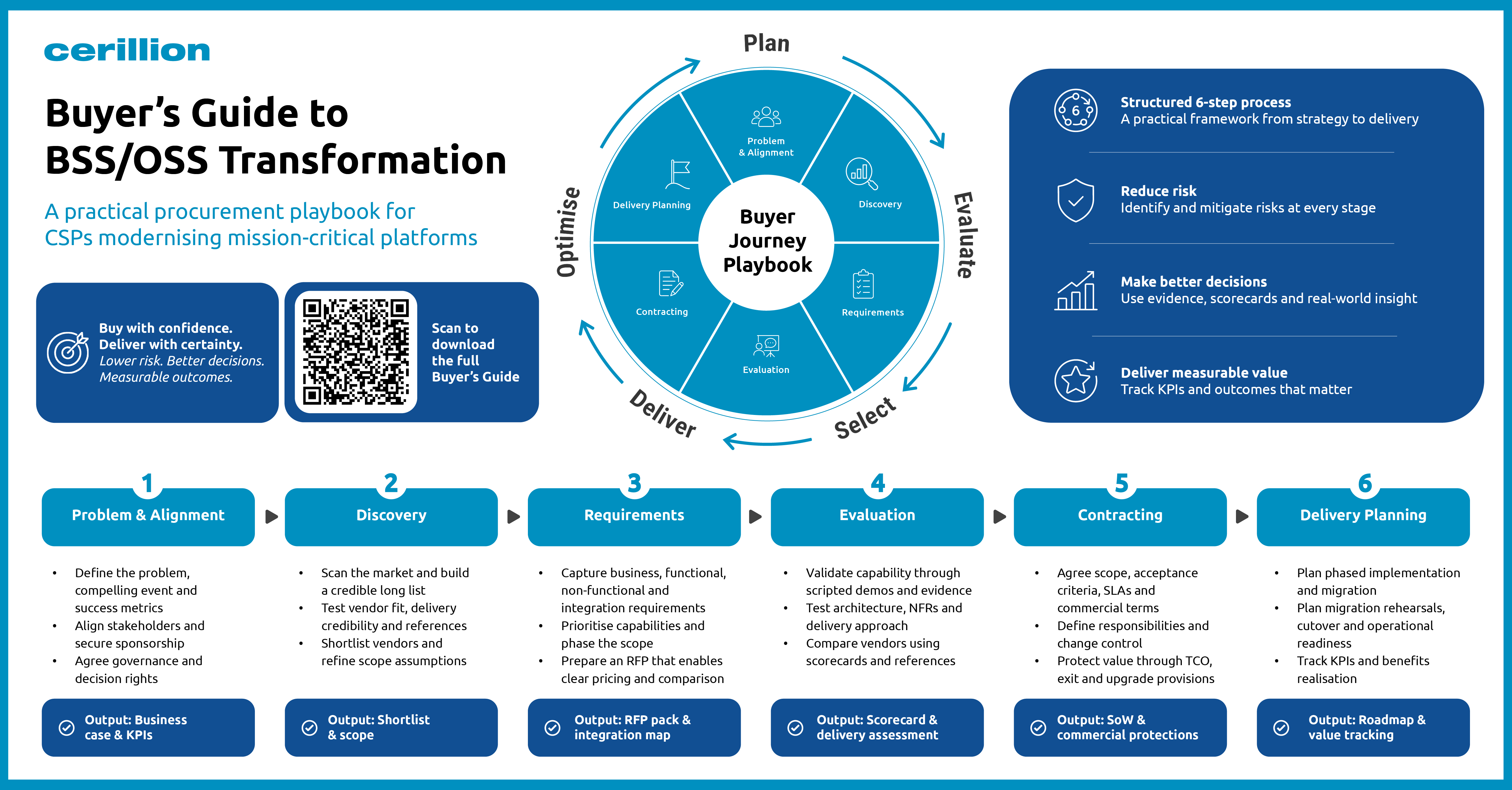
To summarise the approach, we’ve created a visual summary of the six-step Buyer Journey Playbook from the guide. You can view it below and download it to share with colleagues involved in your transformation programme.
Infographic: The 6-step Buyer Journey Playbook for BSS/OSS Transformation
Download the complete guide
These are only a few of the practical recommendations covered in our new Buyer’s Guide to BSS/OSS Transformation.
The guide includes a six-step Buyer Journey Playbook, stakeholder checklists, procurement templates, evaluation scorecards and practical advice to help CSPs reduce risk throughout the transformation lifecycle.
Download the full Buyer’s Guide today and build a stronger foundation for your next BSS/OSS transformation.
