
How CSPs can monetise intelligent supply-chain services
Global supply chains for perishable and fragile goods continue to face significant challenges. At DTW26, Cerillion joined industry leaders in demonstrating how AI and seamless connectivity across terrestrial and non-terrestrial networks can transform supply chains. Leonardo Hodgson explains how CSPs can move beyond connectivity and monetise services across intelligent supply-chain ecosystems.
Every day, millions of shipments of perishable goods depend on continuous monitoring and reliable connectivity. Yet fragmented operations and gaps in coverage often lead to spoilage, damage, delays or unnecessary waste. According to the World Health Organisation (WHO), every year, nearly half of all vaccines are wasted because of cold chain failures, limiting access to life-saving healthcare for millions of people around the world.
Cerillion returned to DTW Ignite 2026 as a participant in the Hyperconnected Intelligent Network of Trust (HINT) for Supply Chain – Phase III Catalyst project, building on the success of Phase II in 2025 to address this challenge.
The project demonstrated how continuous connectivity across terrestrial and non-terrestrial networks (TN/NTN), combined with AI-driven intelligence and real-time IoT data, can create a more resilient, transparent and efficient global supply chain.
Rather than simply monitoring shipments, the Catalyst showed how AI can analyse live operational data to predict issues before they occur, recommend corrective actions and coordinate responses across multiple organisations. The result is an intelligent supply chain that is more proactive and collaborative.
For CSPs, this represents an opportunity to move up the value chain. Rather than selling connectivity alone, they can combine network coverage with data, automation, service assurance and partner orchestration to offer and monetise outcome-based supply-chain services.
A collaborative industry initiative
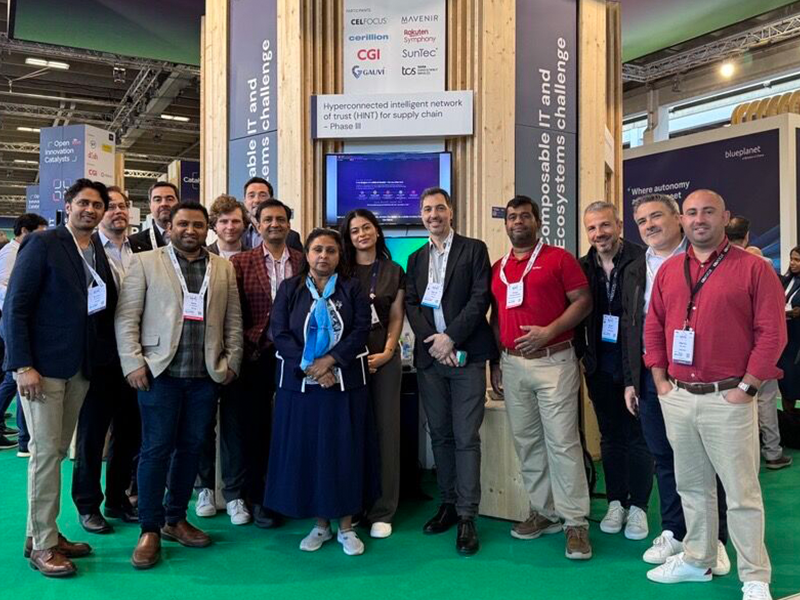
TM Forum Catalysts bring together CSPs, technology suppliers and industry partners to develop proof-of-concept solutions that solve real business challenges using TM Forum’s frameworks and standards, including Open Digital Architecture (ODA), Open APIs, the SID information model and eTOM business processes.
The Hyperconnected Intelligent Network of Trust (HINT) Catalyst was championed by Airbus, Elisa, Skylo, TELUS and Terrestar, with participants including Cerillion, Celfocus, CGI, Gauvi, Mavenir, Rakuten Symphony, SunTec and TCS.
The project showcased how AI, terrestrial and non-terrestrial connectivity (TN/NTN), IoT and composable digital platforms can work together to enable real-time shipment monitoring, intelligent decision-making, ecosystem orchestration and commercial settlement across multiple organisations.
Together, the team developed an end-to-end blueprint demonstrating not only how CSPs can become trusted digital partners in global supply chains, but also how these multi-party services can be commercially managed and monetised.
Cerillion’s contribution
Cerillion’s BSS/OSS suite provided the commercial foundation for the solution, enabling the monetisation and settlement of complex, multi-party supply-chain services across three key areas:
Commercial modelling and partner agreements
Cerillion defined the commercial framework for the ecosystem, including customer contracts, service level agreements (SLAs), wholesale agreements and partner revenue-sharing models.
Real-time charging and usage management
As shipments moved through areas served by different terrestrial and non-terrestrial connectivity providers, Cerillion captured and processed the associated usage events in real time, maintaining traceability and exposing billing information through standards-based APIs for downstream business processes.
Billing, settlement and revenue management
Cerillion enabled end-to-end billing and settlement across the partner ecosystem, supporting customer billing, wholesale settlement, automated revenue sharing, partner invoicing and AI-powered explanations that help partners understand how complex billing and settlement amounts have been calculated.
Together, these capabilities demonstrated how CSPs can monetise sophisticated digital ecosystems rather than simply providing network connectivity.
Industry recognition at DTW
The HINT Catalyst attracted significant interest throughout DTW, with visitors looking to understand how AI, satellite connectivity and composable IT can transform enterprise supply chains. The award judges were impressed too, with the project winning the Best Moonshot Catalyst Award in the Composable IT and Ecosystem challenge from a field of 15 Moonshot Catalyst teams.
The award recognises the Catalyst’s vision of enabling CSPs to participate in high-value enterprise ecosystems through ubiquitous connectivity, intelligent automation and trusted multi-party collaboration. By combining terrestrial and non-terrestrial networks with AI-enabled decision-making, edge intelligence and standards-based interoperability, HINT demonstrated both the central role that CSPs can play in the future of global supply chain operations and the operational and commercial capabilities they will need to capture that opportunity.
Connectivity alone is not enough. CSPs must also be able to define services, manage partner agreements, measure consumption, allocate revenue and explain charges across every participant in the value chain. For Cerillion, the project demonstrated how our BSS/OSS platform can provide this commercial foundation, helping service providers turn complex, multi-party ecosystems into viable new digital business models.
