
DTW26 review: from AI hype to the autonomous enterprise
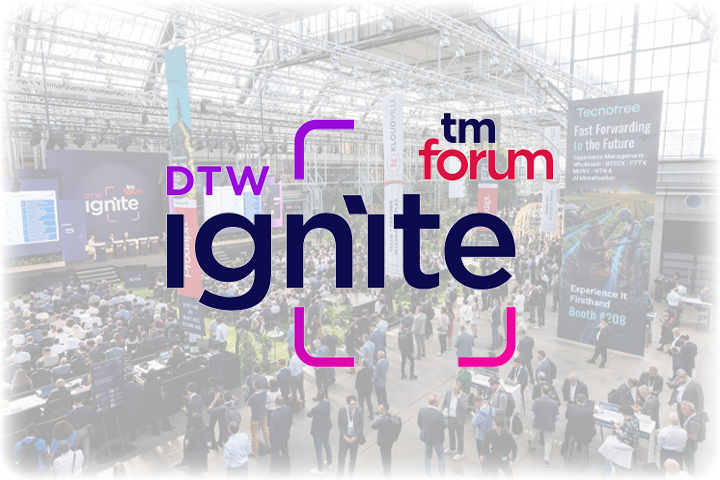
At DTW26, it was clear that telcos have stopped tinkering with AI, and are now serious about embedding it at the heart of their businesses. In his review of this year’s show, Brian Coombs asks – has the industry finally moved beyond the hype?
A week on from DTW 2026, I’ve been reflecting on a busy and fruitful three-day event.
First things first: I’m calling it – we’ve hit peak AI saturation.
Even the typically practical TM Forum keynote address was leaning heavily into the notion that AI will solve everything, provided you move faster and do stuff.
Regular readers will know that I’m a firm believer that AI has a major role to play in both products and organisations, so, beyond the hyperbole, what were the real takeaways?
Moving towards an autonomous enterprise was the stated goal, and I was pleased to hear much of it aligned with things we’ve been saying and doing at Cerillion.
AI agents
Agentic AI should sit alongside, not replace, a trusted core of deterministic systems of record. When talking about our AI stack, I’m very conscious and deliberate about calling out the TM Forum Open APIs as the foundation to the whole thing. They expose the business logic, control the authorisation and authentication, and ensure nothing gets through without the right governance.
Trustworthiness
A great statistic revealed at the event was that 72% of telcos said their AI is trustworthy, but only 18% could prove it, perfectly illustrating why governance matters. TM Forum’s proposal is for a governed execution layer for AI as part of its move to an AI-native ODA; this maps neatly onto our AI Management Centre, which provides you with a full audit trail of exactly how AI agents make their decisions.
Avoiding vendor lock-in
While not explicitly called out, the recent US government directive requiring Anthropic to disable access to Fable 5 and Mythos 5 underlines the point. If you’re using a third-party service, access and usage terms can change quickly, so you need other options or the ability to run the models yourself. One of the first things Cerillion decided was that we would not dictate a particular model. As part of our AI Management Centre, we have built a model abstraction layer that enables operators to switch models or providers without disrupting the services that rely on them.
Open data and architecture
There was, unsurprisingly, a strong push for Open APIs and the ODA – and rightly so. AI agents may be more capable than strictly deterministic programs at dealing with inconsistent data, but the more structured your data is, the more control you have and the better your results will be. Cerillion’s API-first architecture and proven delivery capabilities have given us a great foundation to build upon.
From AI use cases to native flows
Instead of simply responding to prompts, AI-native flows understand intent and context, reason over data, execute actions through governed systems, and record evidence throughout the process. Cerillion was involved in an award-nominated catalyst project showcasing exactly this – more on that below.
Overall, the case being made here was that it’s no longer enough to experiment with AI through fragmented pilot programmes; operators need a coherent, enterprise-wide approach to embedding AI across core business and operational processes. The tagline was “The future. Faster.” and this is how TM Forum thinks you’ll get there.
Elsewhere in the show, this year was a record-breaker for the number of Catalyst projects, and Cerillion was well represented, with two Moonshot Catalysts attracting attention and award nominations:
Hyperconnected intelligent network of trust (HINT) for supply chain – Phase III explores how terrestrial and non-terrestrial networks, advanced AI and intelligent edge capabilities can be brought together to support more resilient, transparent and sustainable supply chains. The project focused on the problem that around 25% of vaccines currently go to waste due to problems during transit and transfer from land to sea.
Value-driven agentic AI marketplace for mega events demonstrates how CSPs can deliver high-performance connectivity for large-scale events through an agentic AI marketplace, where autonomous agents collaborate under defined policy guardrails to match event requirements with the right business and network capabilities. The goal was to show that these kinds of events no longer require planned integration work; it can instead be done dynamically using intent-based orchestration and agent-to-agent (A2A) collaboration.
Both projects were nominated for Best Moonshot Catalyst in the Composable IT and Ecosystem challenge, and we were delighted to see the HINT project named as the winner!
In the session tracks, Louis Hall, Cerillion CEO, and John Walsh, Director of Technology Transformation at Virgin Media Ireland, were panellists discussing “Migrating from monolith to modular – de-risking the journey and accelerating value”. They shared practical lessons from Virgin Media Ireland’s transformation journey, including how a modular, API-first approach can reduce migration risk while delivering incremental business value, without relying on a “big bang” replacement.
Away from the conference sessions, one of the highlights of DTW was time spent on the Cerillion stand, where many of the same themes came through in customer and prospect conversations: AI governance, integration, product agility and the practicalities of moving from legacy systems to more open, modular architectures. We also had the opportunity to demonstrate Cerillion 26.1, our latest product release, and it was encouraging to see so much interest in the new capabilities.
DTW this year showed that the industry’s AI conversation is maturing. The focus is moving away from experimenting with isolated AI use cases and towards the governance, architecture and operational foundations needed to make AI part of everyday enterprise operations. Organisations that build agentic AI on trusted systems of record, governed execution, Open APIs and structured data – while retaining the freedom to change models or providers – will be the ones best placed to move towards the autonomous enterprise.
So, peak AI saturation? Well, as every mountaineer knows, just because you’ve reached one peak, it doesn’t mean there isn’t a bigger one right behind it!
See you next year to find out.
